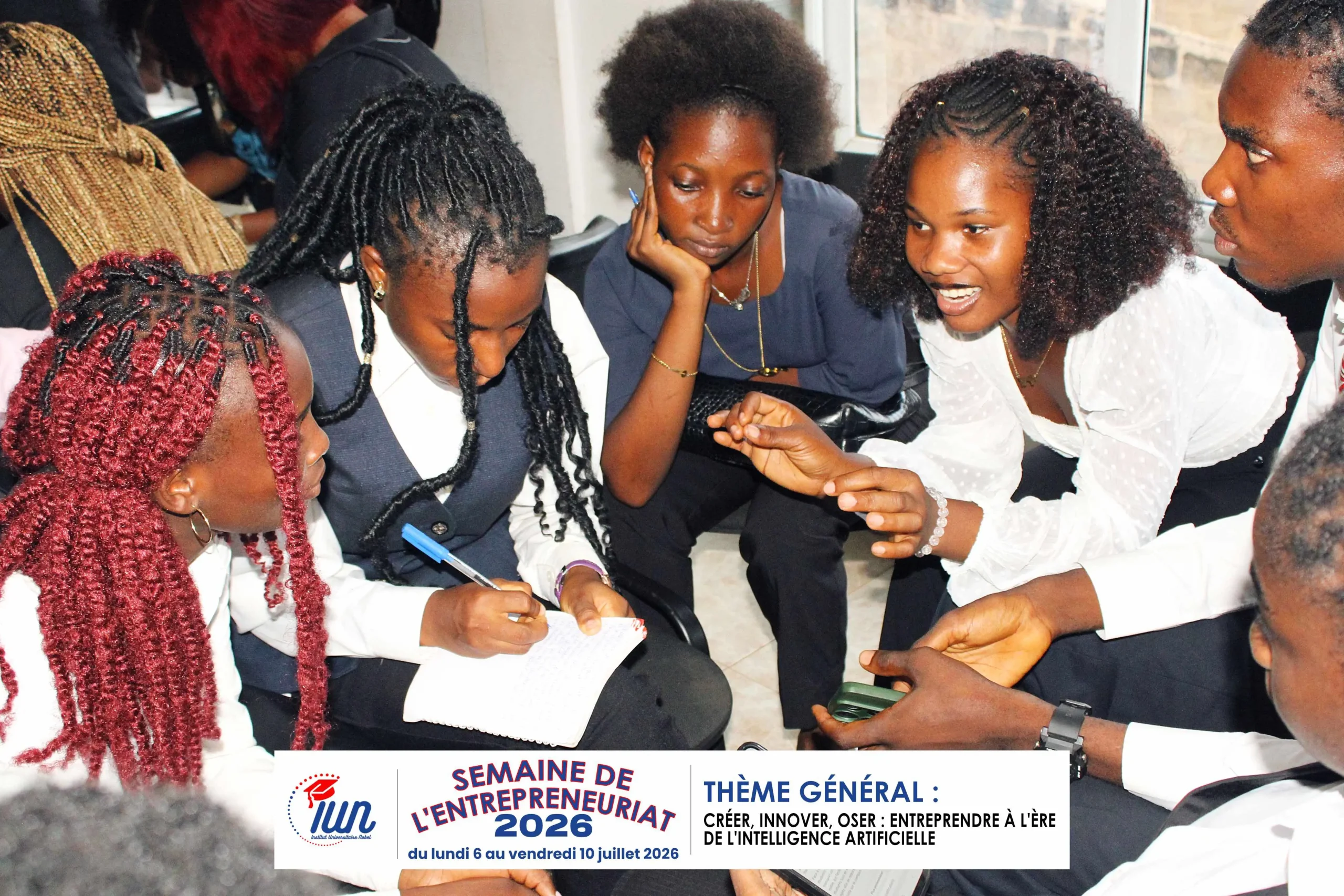
From July 6 to 10, 2026, the Nobel University Institute (IUN) dedicated five days to a strong conviction: a degree opens doors, but skills, initiative, and perseverance keep them open.
Far from a week of traditional lecture-style classes, Entrepreneurship Week 2026 placed students at the heart of real-world situations. They were led to identify real problems, meet affected people, research information, build solutions, and gradually turn those solutions into business concepts.
A significant focus was also placed on Artificial Intelligence—used not as a shortcut, but as a genuine tool for reflection, research, and structuring.
By the end of the week, every participant had traveled the path from an identified problem to a clearly structured business concept: an experience focused on practical skills rather than pure theoretical knowledge.

Day 1 — Why a Degree Is Not Enough
The week kicked off with IUN General Director Dr. Gnacadja Gilles and Dr. Ahonon Marius, who invited students to take a different look at their academic journey.
The message was clear: in the professional world, a degree matters, but it isn’t enough. Practical ability, creativity, communication, initiative, and problem-solving skills are equally decisive.
Students were also made aware of obstacles that can hold back their progress: the excessive pursuit of comfort, a lack of clear personal goals, and an unwillingness to step outside their comfort zone.
The day concluded with the formation of seven mission groups:
- Commerce
- Civil Engineering
- Environment
- Agriculture
- Tourism
- Healthcare
- Education
Each group received a real problem to explore within its sector: small businesses struggling to leverage platforms like TikTok, tourists unfamiliar with Togo’s attractions, or high school graduates having difficulty choosing their university major.
The initial directive was deliberately simple:
Search before you imagine.
Students had to reach out to real people to better understand the problem before thinking about a solution.
Day 2 — Testing Ideas Against Reality
The second day started with presentations of field survey results.
Students discovered a fundamental reality of entrepreneurship: in most sectors, someone is already offering a solution close to what you envision.
Therefore, the challenge isn’t necessarily finding an idea nobody has ever had. It often lies in understanding how to offer a better solution, reach customers differently, and create more value.
Facilitators then introduced a structured framework for using Artificial Intelligence in entrepreneurial project design.
Students learned how to:
- submit an idea to an initial AI tool;
- use the output to refine their thinking;
- draft a more precise prompt for another tool;
- analyze and evaluate the generated responses;
- identify inconsistencies or gaps;
- correct and iterate;
- progressively structure a real business project.
The goal was never to ask AI to "do the work."
On the contrary, students were encouraged to challenge, verify, correct, and improve generated results. AI was thus presented as a thinking partner, not a substitute for human thought.
 Day 3 — Moving from Demonstration to Autonomy
 Day 3 — Moving from Demonstration to Autonomy
Day three marked a real turning point.
After observing and understanding the method, students were invited to put it into practice using their smartphones and laptops.
They worked on their problem statements, narrowed down target markets, deepened research, and strengthened their solutions.
Meanwhile, facilitators roamed the room, answering questions and providing guidance whenever needed.
The shift was visible: students were no longer mere spectators of a methodology. They were becoming capable of applying it independently.
Day 4 — Skills That Don’t Appear on a Business Plan
The fourth day shifted focus toward another essential dimension of professional success: soft skills and personal conduct. Punctuality, personal presentation, honesty in professional relationships, communication, discipline, and resilience after failure were central to discussions.
Facilitators reminded students that a good idea is not enough to build a career or a business.
Entrepreneurship also relies on mindset, discipline, and reputation. How a person presents themselves, honors commitments, communicates, and acts in small everyday situations gradually determines the trust others place in them.

Day 5 — From Idea to Pitch
On the final day, each student presented an independently developed business concept, drawing on research conducted throughout the week and AI workflows.
The presented projects covered various sectors and showed different levels of maturity.
Yet they all shared one common thread: they stemmed from a real problem and offered a concrete response.
The week wrapped up with an interactive session led by Dr. Herman Mensah Jean, Founder and Promoter of IUN. Driven by student questions, discussions touched on failure, consistency, and the traits needed to build a sustainable entrepreneurial path.
Among these qualities, Dr. Herman Mensah Jean emphasized one key value: reliability. He specifically cited Dr. Ummennadike Innocent, a university community member whose constant availability helped build trust and open up opportunities.
An important reminder: reputation is not built solely on grand achievements. It is also built through the small commitments you honor every day.
Key Takeaways for Students
Entrepreneurship Week 2026 was designed to deliver skills immediately applicable in professional and business contexts.
- Market Research: Identify a real problem, interview target audiences, and validate the need before building a solution.
- Applied AI Usage : Learn to use multiple AI tools in a structured, critical, and verified workflow.
- Business Plan Development : Transform a validated problem and idea into a structured, well-supported, and documented proposal.
- Digital Marketing Insights : Understand that visibility, communication, and reaching customers can be just as crucial as product or service quality.
- Professional Conduct : Develop punctuality, personal presentation, communication, integrity, and discipline.
- Public Speaking: Learn to present and defend an independently developed idea in front of an audience.
These skills obviously do not end with the week. They can be applied during job interviews, internships, academic projects, teamwork, or starting a new venture.
What Comes After Entrepreneurship Week?
Entrepreneurship Week 2026 reflects a broader ambition of the Nobel University Institute: to train students capable of understanding their environment, identifying problems within it, and turning those problems into opportunities for value creation.
The goal is not simply to graduate students. It is to train young people who can search, analyze, create, communicate, adapt, and act.
Because beyond the degree, the real question is knowing what you can do with it.
IUN thanks all facilitators, speakers, and students who contributed to the success of this edition.
A week has come to an end. But for the students, the real work begins now: turning ideas into projects, projects into action, and action into results.
Institut Universitaire Nobel (IUN)
Building skills. Revealing talent. Building the future.